Education

Our great martyred leader, the Quaid e Awam, believed that education was the key to empowerment of the people. He introduced free and compulsory primary education, promoted centres of excellence, created Institutes of Science and Technology and took Pakistan to the cutting edge of nuclear physics establishing centres of nuclear medicine. He set up a chain of new Universities, Medical and Engineering colleges in the neglected areas as a harbinger to a Muslim renaissance.

Western countries developed by encouraging free debate in universities of excellence which produce the men and women needed to govern great nations.

  • Enhancement of Computer Literacy Program

Textbooks to government primary schools will be provided free of cost while a means test will make students eligible for additional government support. Libraries will be promoted and vocational centres, on the pattern of the Computer Literacy Program, enhanced.

  • Access to the Internet

Internet access for government schools will enable the children of the underprivileged to access the worldwide information highway. The global language, English, will be an optional language for students to study preventing lingual apartheid where children of the rich speak English competing for world wide jobs and children of the working classes are denied that opportunity.

  • Increase in Education Budget

Seeking an age of reason and enlightenment, the PPP, which increased with extra billions education budget in its two recent terms of power, pledges to make education a top priority. It is education, and education alone that can enable our young people to realise their full potential and compete with the best that the world can produce in the field of art and science.

PPP Parliamentarians commits to its sons and daughters an education that enables a brighter future than that of their parents so that they can hold high their head in the comity of Nations.


Read more...

You can imprison a man, but not an idea. You can exile a man, but not an idea. You can kill a man, but not an idea. -- Benazir Bhutto

My country mourns. And as my countrymen join me in personal grief over the loss of my mother, I join them in national grief over the loss of something even greater: the loss of Pakistan's greatest voice for democracy.

Benazir Bhutto's death, however, shall not have been in vain. We will go forward, as she would have wanted, and bring freedom and democracy to Pakistan.

For those in my country who would find it easier to walk away from democracy and seek revenge through violence, I urge you to remember my mother's words: democracy is the sweetest revenge. To plunge the country into more violence and chaos would only play into the hands of those who hope for democracy's failure. The terrorists have no use for democracy, and the current government fears it. We must unite and rise above both.

And to those outside of my country, who support our fight for democracy, I urge you to consider this: We cannot oppose one form of tyranny while turning a blind eye to another. Together, we must stand against the violence of the terrorists on the one hand, while standing equally firm against Pervez Musharraf's use of it as an excuse to impose his own repressive will upon the people of Pakistan.

Musharraf has made a mockery of our constitution. The world watched in disbelief as he declared emergency rule and sent troops into the streets in November – not because of a terrorist threat to the government, but a constitutional threat to his autocratic grip on power. The men he threw into jails were not terrorists but Supreme Court judges and respected lawyers. The newspapers he intimidated were not organs of terrorists but of free and independent citizens of Pakistan.

My mother stood bravely against both the tyranny of terrorism as well as the tyranny of dictatorship. She has been martyred for her courage and pursuit of pursuit of freedom, but now that courage and pursuit has been bequeathed to the to the people of Pakistan. We shall carry on.

It will take the kind of courage my mother showed showed. It will take courage among her loyal followers to calm their anger and renounce violence or revenge. We must instead demand fair and open elections, free of government intimidation, and then make our show of force on election day.

It will also take courage on the part of Pervez Musharraf and those who have supported his government, including those outside of Pakistan.

With my country's judges and lawyers still in jail, its free media intimidated and silenced, and its political leaders unsafe to walk the streets, we cannot pretend to have free and open elections. There can be no legitimacy to elections held under such ominous conditions. Those who espouse the virtues of democracy cannot stand by idly and maintain their credibility while this repression continues.

Our free and independent Supreme Court must be restored; the justices jailed by Musharraf must released and returned to their proper seats, replacing the cronies with which Musharraf has packed the current court. Our other judges, lawyers and civic dissidents must be freed. The intimidation campaign waged against the free media must be halted. International election observers must be allowed to monitor our elections to ensure against government intimidation. And, finally, a credible international commission must be allowed to investigate the mysterious circumstances of my mother's assassination. Only after these steps are taken can we begin the honorable march to democracy and stability.

For those who think that by supporting dictatorship they are somehow securing stability in Pakistan, I can say only this: Where is that stability today? My country teeters on the precipice of anarchy not because of any actions by radicals or terrorists but because of the unchecked and power-mad actions of a military dictator.

Pakistanis will soon hold the most important election in our history. We have reached a tipping point. We will either unite behind democracy and the fight against radicalism and violence, or we will descend into the all-too-familiar cycles of despotism, terror and instability.

Those of us who will fight for democracy must make our stand now. Then, together, a united and democratic government can turn its attention to the extremists and terrorists who seek to undermine freedom in our country and throughout the world.


Read more...

Gillani was born into a prominent family of landowners from the Punjab province, many of whom were involved in politics, including his father, who was a provincial minister during the 1950s. After studying at the University of Punjab (M.A., 1976), Gillani joined the Pakistan Muslim League (PML) in 1978. In 1985 he was elected to the federal parliament, but a conflict with Prime Minister Mohammad Khan Junejo led to his replacement and eventual marginalization within the PML.

Gillani joined the Pakistan People’s Party (PPP) after Pres. Mohammad Zia-ul-Haq dismissed Junejo’s government in 1988. The PPP returned to power under Benazir Bhutto following Zia’s death in a plane crash later that year. Gillani served as speaker of the National Assembly (1993–97) during Bhutto’s second term as prime minister. Bhutto was removed as prime minister in 1996, and in elections the following year the PPP suffered a decisive defeat. Gillani, who remained a senior member of the PPP, was arrested in 2001, on charges of granting illegal government appointments while he was speaker, and served more than four years in prison, though he maintained his innocence.

In October 2007 Bhutto returned to Pakistan from self-imposed exile to lead the PPP in general elections called for early 2008. In December 2007, however, she was assassinated. Following her death, Bhutto’s husband, Asif Ali Zardari, became head of the PPP, which managed to win the most seats in elections held in February 2008. The PPP subsequently negotiated a coalition agreement with Nawaz Sharif’s Pakistan Muslim League–Nawaz. With Zardari ineligible to become prime minister, because he had not been elected to parliament, in March the PPP selected Gillani to become prime minister.


Read more...
Security was discreetly stepped up as the new term started on Monday at Oxford University, where Benazir Bhutto’s son has vowed to complete his student life despite being named her political heir.

Bilawal Bhutto Zardari returned to his first-year history studies at Christ Church College after being named Ms Bhutto’s long-term successor as Pakistan People’s Party head following her assassination in December and looming elections.

Scotland Yard has been drafted in to protect the 19-year-old in a top secret operation which one security industry source said would cost “thousands and thousands” of pounds a month.

Despite this, Christ Church -- founded in 1529 -- was still open to visitors on Monday and, as usual, bowler-hatted porters manned its gates rather than police, although there seemed to be more officers than usual patrolling the street outside.

While the college has reassured students they have no reason to suspect a “direct threat” to Mr Bilawal, some in Oxford have already expressed concerns that his presence could pose dangers to others in the city.

“Go home, you endanger us all here in Oxford by being here,” one person wrote on the website of the local Oxford Mail newspaper, while another was hostile to the idea that British taxpayers would pay for his security.

“Idiots from his country want to kill him but I bet the British taxpayer is footing the bill for his security,” another added.

“Go home now and take the dangers you pose to others with you.” Scotland Yard, which is overseeing the security operation, would not discuss arrangements to protect Mr Bilawal, while Oxford University also declined to comment.

But Mike Faux, of private security firm Executive Group Holdings, who has worked with footballer David Beckham, the British royal family and singer Michael Jackson, told AFP it would cost “thousands and thousands” of pounds a month to guard him.He said he thought Mr Bilawal would likely have armed guards 24 hours a day who would use tactics such as decoys and convoy vehicles to protect him.

Mr Faux said Bilawal was now a higher security risk than anyone in Britain, including future king Prince William, and questioned the wisdom of his returning to university so soon after his mother’s killing.The officers protecting him would currently be on “code red”, he added.

“You’ve got a man here whose mother has been killed, he’s now a very high threat himself and he’s going about his life as a normal individual,” he said.

“What happens is the client wants to live a normal life, particularly at that age with parties... his advisers should be telling him no, he can’t do that.

“He wants to live a normal life but unfortunately he can’t... she (Benazir) did -- she said I’m going to carry on as I have -- but it cost her her life.” Christ Church seems keen to help Mr Bilawal realise his stated aim of being just like any other student at Oxford.

In an email sent to students just before the start of term, an official wrote: “We have at present no reason to suppose that there is any direct threat to Bilawal, but we do have a responsibility to try to ensure that he is able to lead a normal life as an undergraduate and benefit to the full from his time at Christ Church,” the Oxford Student newspaper reported.

But this may prove even more difficult than authorities at the college -- also attended by Mr Bilawal’s grandfather Zulfikar Ali Bhutto, a former prime minister, -- anticipate.

While Oxford is used to high-profile students -- others in recent years include Chelsea, daughter of then United States president Bill Clinton, and former British premier Tony Blair’s son Nicky -- none came with such a bloody political pedigree as Mr Bilawal.—AFP
Read more...
Former Prime Minister Benazir BhuttoA survey conducted by Los Angeles Times has revealed that most Americans of Pakistani descent feared that the recent happenings in Pakistan, including the assassination of Benazir Bhutto, crackdown on Opposition parties and the general political chaos, had further deepened the negative impression about Pakistanis in the US.
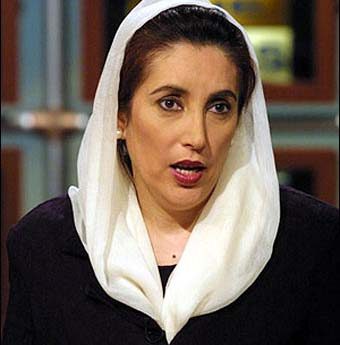
It was found that after these incidents, while some Americans perceived that Pakistan was a country where Al Qaeda chief Osama bin Laden lived, others thought Pakistan was a militant Arabic-speaking Mideast country.


Read more...

Slain former Pakistan premier Benazir BhuttoIn an honour to slain former Pakistan premier Benazir Bhutto, the prestigious Oxford Union Debating Society organised a debate in her memory.
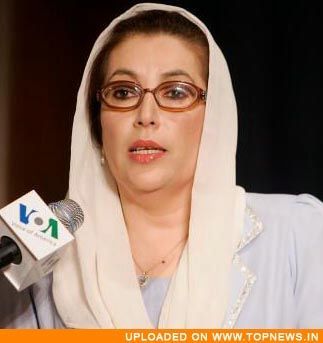
Incidentally, Benazir was Society’s ex-president in 1977 while she studied at the Oxford.

The debate was attended by Benair’s former colleagues, students and friends, besides her 19-year-old son Bilawal Bhutto Zardari, who is a first year student at Christ Church College, reported the Dawn.


Read more...
Central Intelligence Agency (CIA) Director
Michael Hayden is of the view that the al-Qaeda and militant Pakistani
tribal leader Baitullah Mehsud were responsible for the December 27,
2007 assassination of former Prime Minister Benazir Bhutto.

In an interview given to the Washington Post, Hayden said Bhutto
was killed by fighters allied with Mehsud, a tribal leader in
northwestern Pakistan, with support from al-Qaeda's terrorist network.


Read more...
former Pakistan premier Benazir BhuttoSlain former Pakistan premier Benazir Bhutto did not want her party leaders to accompany her in her car in Karachi because she apprehended a suicide attack and did not want other party leaders to fall prey to it. PPP leader Nisar Ahmed Khuhro wrote this in an article published in a local paper in Karachi.

He wrote that before arriving in Karachi on October 18, Benazir had said that she did not want any party leader to accompany in her car, but no one agreed with her suggestion


Read more...
Slain former premier Benazir BhuttoA teenage suicide bomber, who was arrested in Dera Ismail Khan for his involvement in the assassination of former premier Benazir Bhutto, has told interrogators that his next target was the US Consulate in Karachi.
Sources said that Aitzaz had confessed during preliminary interrogation that he had been asked to attack Bhutto in Karachi if she escaped the attack in Rawalpindi.

But after Bhutto’s assassination, Aitzaz had been directed to move to Karachi to target the US Consulate, they said.


Read more...
: ormer Pakistan Prime Minister Benazir BhuttoThe Scotland Yard team probing into the assassination of former Pakistan Prime Minister Benazir Bhutto would be free to interrogate Aitezaz Shah, the 15-year-old arrested in connection with the case, said Interior Ministry spokesman Javed Iqbal Cheema.

The British team is expected to come back to Pakistan in a couple of days with a final report on the case, Cheema said, adding that the report would be presented to the local investigating team and is likely to be shared with the media, the Daily Times reported.


Read more...